
How to Get Leadership Support for Trans Inclusion When It’s Not on Their Radar
A question we often hear from HR professionals is some version of this: “I know this matters, and I can see it affecting people, so how do I get leadership to treat it as a priority?” It’s a fair question and a frustrating one to be stuck with. You may well be the person in your organization who best understands what trans and non-binary employees deal with day to day, but understanding a problem and having the authority to fix it are rarely the same job. The good news is that getting leadership support for trans inclusion doesn’t always mean convincing anyone that it matters. More often, it means making one problem clear enough that someone with authority can act on it.
Key finding: In our survey of 50 HR professionals and organizational representatives, 82% said improving trans and non-binary inclusion mattered to them personally, but only 3 (6%) said their leadership treated it as a high priority.
A name change that took three departments
Here’s a situation that plays out in a lot of workplaces. An employee tells HR they’ve started using a new chosen name, and HR updates their file that same afternoon. As far as HR is concerned, the change has been made.
A week later, though, the old name is still showing as their email display name and still appears in the scheduling system their manager uses to assign shifts. It also turns up on their benefits portal and on a payroll email or letter. Seeing the name that the employee no longer uses, also known as a deadname, can be genuinely painful, and every time it turns up, the employee is reminded that a change they thought was settled hasn’t really happened fully and is left wondering who else has seen it, especially clients or members of the public.
When they go back to HR, HR emails IT, who explain that the directory syncs from a system they don’t control. Payroll says some records need a legal name, but isn’t sure which ones. Every one of those answers is reasonable on its own, and nobody involved is trying to be difficult. Two months later, though, still nothing has changed and the employee is consistently passed off to other people or teams. The employee is exhausted and frustrated - this is not the only place they are having to run around.
What’s missing is someone with the authority to bring those three teams together and make sure the problem has adequate resources and is fixed by a set date. Often, that person sits above HR.
Survey: how HR rates leadership’s priority on trans inclusion
Earlier this year we ran a survey of 50 HR professionals and organizational representatives. It’s a small study, and more research would be needed to get a clearer overall picture, but one pattern stood out.
Of the 50 respondents, 41 (82%) said improving trans and non-binary inclusion mattered to them personally, at least to some degree. When we asked how they thought their leadership saw the same issue, the answers looked quite different.
How respondents rated their leadership’s priority for improving trans and non-binary inclusion
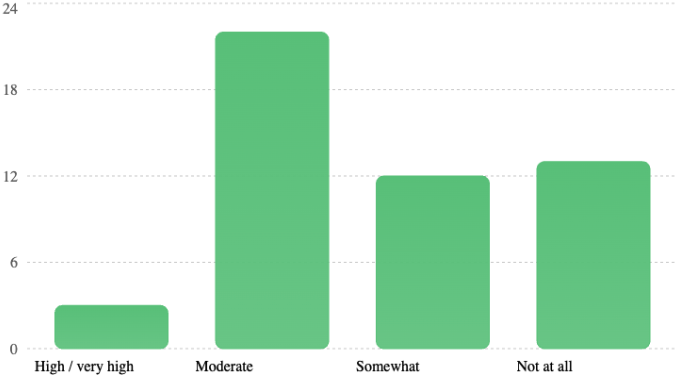
Only 3 people said their leadership considered it a high or very high priority, while 13 said it wasn’t a priority at all. Most respondents put their leadership somewhere in the middle.
Why “it’s the right thing to do” doesn’t always land
Even where leaders are genuinely supportive of trans inclusion, support in principle doesn’t come with a budget line, a project owner or a deadline attached.
Leaders spend much of their time choosing between competing problems. The ones that get attention tend to be specific, easy to picture and connected to a clear fix. A statement like “we should be more inclusive of trans employees” doesn’t meet any of those tests. It’s a statement of values, and while it’s easy to agree with, it doesn’t tell anyone what to do next.
An old name sitting in the scheduling system is a very different kind of issue, because it’s concrete, someone can be made responsible for it, and everyone will know when it’s been fixed. Many of the barriers to trans inclusion in the workplace are this kind of everyday, operational problem, whether it’s a form, a system, a washroom or a manager who isn’t sure what to do. Most of them can be fixed. They just tend to sit across several departments, which means nobody fixes them by default.
These problems also often don’t show up as formal complaints. As we explored in Why Trans Employees Don’t Report Discrimination at Work, HR can’t rely on complaints alone to know where problems exist.
How to make the business case for trans inclusion to leadership
It helps to start with one specific problem that leadership can easily understand, so let’s go back to the name change and look at how HR might take it to leadership.
Before using anyone’s situation as an example, check with the employee first. Ask whether they’re comfortable with it being raised and how much detail they’re happy for you to share. You can usually make the case without identifying anyone, and the employee may be able to tell you places the old name keeps appearing that you hadn’t spotted.
Here’s a version of the request that probably won’t get very far:
“We’d like to discuss improving our practices around trans and non-binary inclusion.”
And here’s one that’s much harder to set aside:
“When an employee updates their chosen name, our systems don’t update consistently. A recent name change was approved by HR two months ago, but the employee’s previous name still appears in the email directory, scheduling software and benefits portal. That means they’re being identified in front of co-workers by a name they no longer use, which is a privacy concern and could create human rights risk. It has also taken a significant amount of staff time across three teams without being resolved.
We need IT, HR and payroll to identify and address where employees’ previous names appear unnecessarily, and agree on a consistent process for future requests.”
The second version doesn’t ask leadership to care more. It explains what’s happening and what it’s costing, and it asks for a specific, manageable next step, which is the kind of request a leader can address promptly and effectively.
It’s also worth noticing that the request isn’t really about one employee, but about a process that could let others down in the same way in the future, even if they are not trans. Framing it like this can help, because fixing the process means anyone who changes their name in future is less likely to run into the same problem.
If you’d like more help framing issues like this, our free Making the Case to Leaders guide goes into this in more depth.
Where outside expertise makes a difference
You know your organization’s systems, people and constraints better than anyone. But issues like the name change rarely sit neatly within HR, and once a problem crosses several departments, it can be hard to know how to coordinate a solution. You might also be unsure how other organizations have approached something similar, or what the specific implications are for trans and non-binary employees. On top of that, leadership will often want a clear picture of the practical options before they approve anything.
That’s where we come in. At TransFocus, we bring specialized experience from helping more than 500 organizations work through these kinds of challenges, and we work alongside your team rather than replacing it. Together, we can identify practical options and give leadership what they need to make a decision, without automatically turning one issue into a major project. Our fixed-scope Compliance-to-Practice Review is designed to do just that.
Where to start with trans inclusion in your organization
Fixing the name change didn’t require a new organizational strategy. It needed someone to recognize that an administrative problem had real consequences for an employee, identify the departments involved and coordinate a workable solution. That’s often how leadership support begins, with one specific problem made clear enough to act on.
If you’re not sure where gaps like this exist in your organization, our free Compliance-to-Practice Checklist takes about 10 minutes. It walks you through your policies, systems, facilities and everyday interactions so you can spot where compliance with gender identity protections looks fine on paper but isn’t translating into practice, and find the issue that’s most worth taking to leadership first.
[Button: Download the free Compliance-to-Practice Checklist]
Frequently asked questions
How can HR get leadership support for transgender inclusion?
The most effective approach is usually to bring leadership one specific problem rather than a general goal. Describe what’s happening, who it affects and what it’s costing, and then ask for a small, clearly defined next step with an owner and a timeline.
What if leadership doesn’t see trans inclusion as a priority?
This often means the issue hasn’t yet been made visible or concrete, rather than leaders being opposed to it. Framing it as an operational problem with real consequences, such as privacy risk, lost staff time or compliance concerns, gives leadership something specific to act on, rather than a question of values alone.
When should HR bring in an external gender inclusion consultant?
An external consultant can help at almost any stage. That includes coordinating a fix that crosses several departments, learning how other organizations have handled something similar, understanding the specific implications for trans and non-binary employees, and giving leadership a clear assessment of the options before they approve changes. An outside perspective can also help you spot gaps you didn’t know were there, so it’s often worth reaching out early rather than waiting until resolving a problem has stalled.